Generated geometry · scroll to walk it

Make it, keep it, and know where it stops.

One pass, in two halves. First three rooms, every object in them produced as a mesh by the same system the rest of this site describes — loaded here as geometry, lit with the rig the photographs use, and moved through by scrolling. Then the door shuts, the camera turns, and the second half follows the work that goes the other way: out of the building, into somebody else’s.

If your browser cannot run it, or you have asked your system to reduce motion, the page becomes an illustrated article. The travel is the only thing that is lost — the rooms become a photograph, the second half becomes a drawing, and the five questions at the end are ordinary text either way.

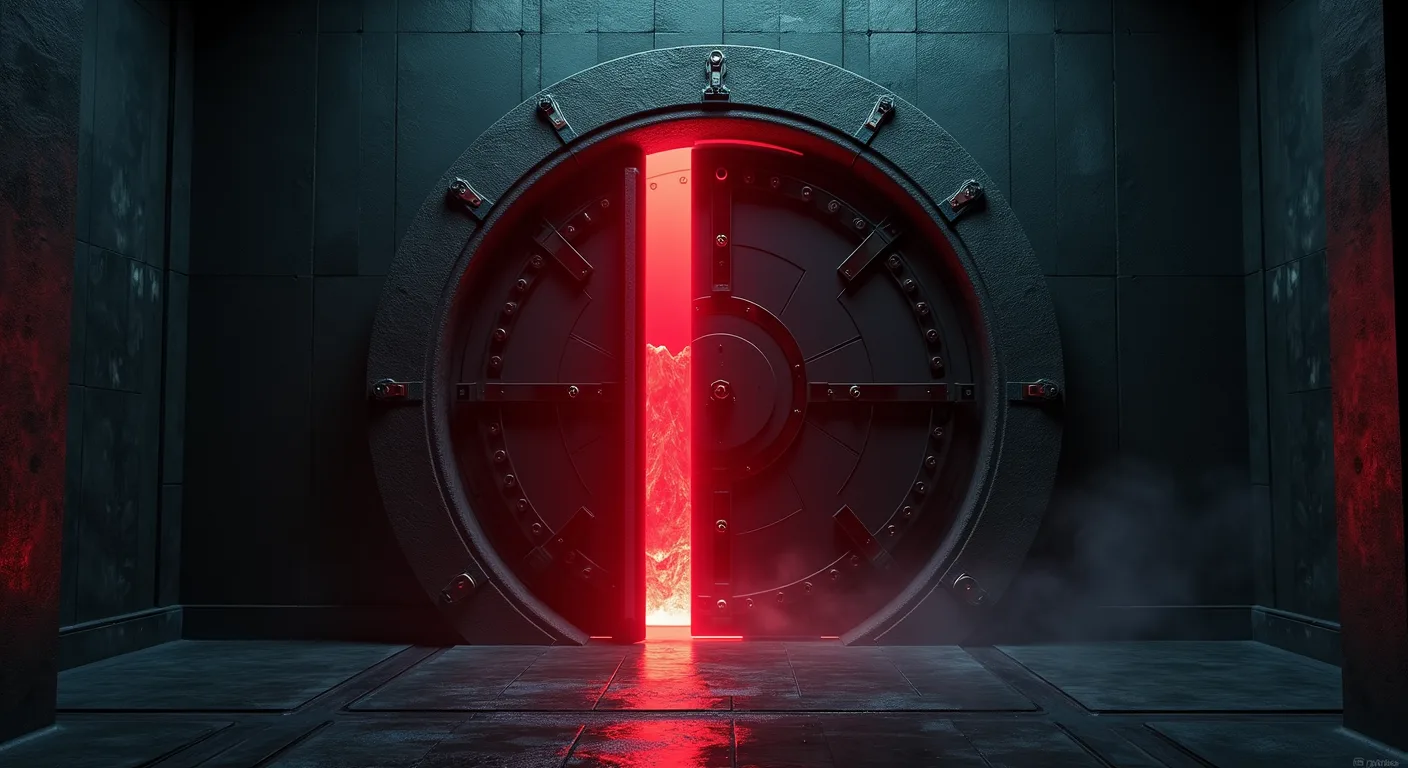
The vault door, rendered from a mesh this system generated.

Three rooms, then the other way out

01 — the object

The Machine

Fifty-nine litres: a regular hexagon 420 millimetres across its corners and 516 tall, 12 printed facets on six posts of 2020 extrusion, six 120 mm fans — three drawing in at the floor, three exhausting through the roof — and one card. The plan is the mark's: a vertex faces the room and carries the one line of garnet, and the seams fall on the figure's own axes because 516 millimetres of face will not print in one piece. The hexagon is as small as the board allows: its flats hold a 330 millimetre board with eight millimetres to spare, and the two wings a rectangle cannot use are the cable bay and the plenum. Scroll, and it comes apart.

02 — where a thing is made

The Forge

Generation is the loud part and the least interesting. The furnace runs on your own machine, the anvil is where the output gets hit until it is the shape you asked for, and neither step leaves the building. What you are looking at was made by the machine this page describes — these are its meshes, not a stock scene.

03 — where it is kept

The Library

Everything the system has read stays where you put it. Documents are ingested, chunked and embedded on the machine, and an answer arrives with the page it came from attached. The shelf is the honest metaphor: retrieval is not memory, it is knowing exactly where you filed something.

04 — where it stops

The Vault

The door is the product. Every outward or irreversible action queues for a human, the gate grants nothing by default, and the audit trail is written whether or not anyone reads it. A system that can act on your behalf is only worth having if you can show exactly where it cannot.

05 — the hinge

The Same Door

That door is where this half ends, and it is the only thing the two halves share. From here the passage follows the other choice: not what anyone does wrong, but what sending means. Nothing ahead is an allegation about a named company — several of them are excellent. It is the arithmetic of a copy, and a copy does not care who is holding it.

06 — one copy becomes two

The First Hand

The instant work leaves the machine there are two copies and you hold one. Everything past this point is a promise rather than a property — a retention window, a deletion endpoint, a region you were told it stays in. A promise can be written well, audited annually and honoured completely, and it is still a promise. The difference is who has to be trusted for it to hold.

07 — and the count is never one

The Fan-Out

One hand becomes several, because serving a request is not one machine. There is an inference host, a load balancer's log, a billing record, a backup of that record, an abuse-review queue, and a subprocessor list under each of those. Every one of them is contracted and competently run. Every one of them is also another place the copy is. Published subprocessor lists are the honest place to count: they are public, they are long, and they change without asking you.

08 — the copies nobody enumerated

The Quiet

Past the subprocessor list is the part no document covers — not because anything is hidden, but because nobody knew to write it down. A debug log that caught a prompt during an incident. A screenshot pasted into a support ticket. A test fixture built from real traffic because synthetic traffic would not reproduce the bug. None of that is misconduct; it is the ordinary residue of running anything at scale. It is also why “deleted” is a claim about the records someone knows about.

09 — ask us the same five

Five Questions

This is the whole argument in the only form that is any use to you: five questions to put to any vendor, this one included.

Where is the copy?
Sent awayEnumerable, in principle: inference host, request logs, billing, backups, and each subprocessor underneath them.
On your machineOne machine. This one.
Who can read it?
Sent awayNot who would — who can. Staff under policy, systems under contract, and anything a lawful order reaches.
On your machineWhoever can log in.
How long is it kept?
Sent awayA stated window, plus whoever may extend it. Backups and legal holds outlive the window by design.
On your machineUntil you delete it.
What else is it used for?
Sent awayAbuse review, evaluation and model improvement are three separate permissions. Read them separately.
On your machineNothing else.
What happens when you leave?
Sent awayWhat is deleted, what is retained, and who verifies which. The third is the one usually missing.
On your machineThe hardware comes back to us; everything it produced is yours and stays.

Scope: the work — your prompts, your documents, the models, the output. This website is a static site on a CDN and is measured on its own terms; the agreement says which, and the agreement is what binds if it and this table ever disagree.

10 — the frame you started from

Back At The Door

This is the frame the first half ended on, and nothing in it has moved. Look back down the trail from here and your own machine is the dimmest thing in the picture — that is what distance does, and it is the honest view from the far end. The forge, the library and the vault are on hardware you can unplug. The other passage is real and legitimate and a great deal of good work goes down it. We built this one.

What you just walked through

The forge is generation — image, video, mesh, speech and music, in your building. The library is retrieval — your documents, ingested and answered with their sources attached. The vault is the autonomy gate — the part that decides what the system may do without asking, and refuses by default.

The second half is not about anybody in particular, and it is worth repeating that it names nobody. It is about what the word “sent” does: the moment work leaves a machine you control, a second copy exists on one you do not, and everything after that point is a promise rather than a property. Plenty of those promises are written well and kept completely. They are still promises, and the trail you just walked is simply a drawing of who has to be trusted for each one to hold.

The same argument in prose, including what this does not do →
See the Garnet Workstation these rooms describe →